The Traditional Drill: The Reliable Standard
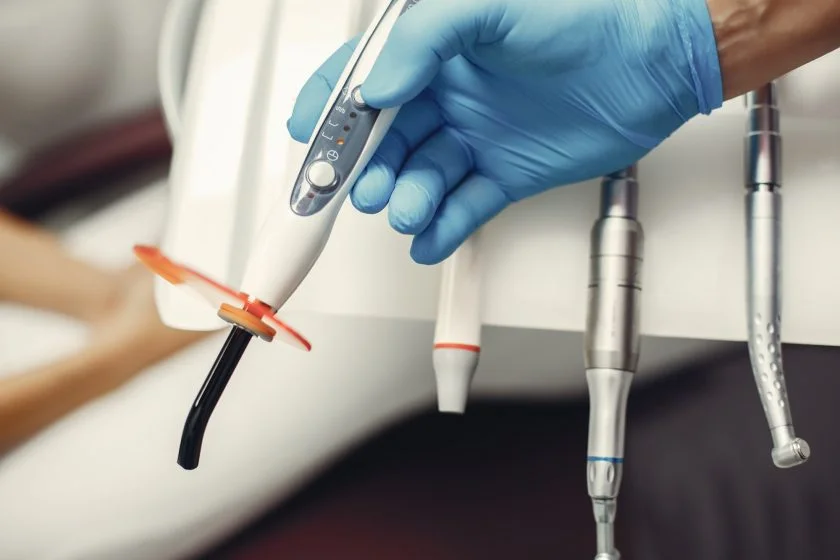
Dentists use a mechanical high-speed drill to extract decayed dental material during traditional filling procedures. The current technology enables better drilling performance because modern drills exceed the speed and accuracy of earlier equipment.
The Clinical Advantages
- Versatility: Conventional drills are the “multitools” of every dental office. They can perform any type of filling, even when removing old fillings containing amalgam. They are also crucial in shaping a tooth for a crown or a bridge.
- Efficiency for Large Cavities: When dealing with large cavities or a lot of structural work, the drill is usually quicker in removing a lot of damaged enamel and dentin.
- Accessibility: Being standard in every dentist’s office, traditional fillings are the most accessible and affordable option, covered in full by dental insurance.
The Challenges
The negative effects of a dental procedure primarily impact how patients experience the treatment. The drill produces both heat and vibration which the dental nerves in the tooth perceive as painful sensations. This requires the “shot” which delivers local anesthesia to block sensation from the targeted region. The vibration from a drill has the potential to produce tiny fractures that develop in healthy enamel which will cause slight tooth damage over a period of decades.
Laser Fillings: The Gentle Innovation
Hard-tissue lasers, such as Er:YAG or WaterLase, utilize a concentrated form of light energy and a constant spray of cooling water to “vaporize” decay on a molecular level.
The Clinical Advantages
- No Needles, No Numbness: This is probably the biggest advantage for most patients. Because lasers don’t create friction heat or vibration, they don’t stimulate pain response. Most patients can get a cavity filled with zero anesthesia. This means you won’t leave the office with a drooping face.
- Micro-Precision: Lasers are highly precise tools. This allows for the removal of decayed tooth structure with a great deal more of the good tooth structure remaining.
- Natural Sterilization: The intense heat of the laser light kills bacteria as it works, effectively disinfecting the cavity. This minimizes the chances of a secondary infection developing around a new filling.
- Better Bonding: The laser etches the surface of the tooth on a microscopic level, giving it a better surface for bonding than a drilled tooth.
The Challenges
Lasers have certain restrictions which limit their usage as they cannot effectively remove existing metal fillings because laser energy results in mercury vapor emission from the metal. The technology proves to be less effective when treating cavities that occur deep between teeth because the laser treatment requires direct visual access to the affected area. The expensive nature of the technology leads some practices to impose higher charges for their laser treatment services.
Head-to-Head: The Patient Perspective
When choosing between these two, it’s helpful to look at how they impact your day-to-day life during and after the appointment.
The “Post-Op” Experience With a traditional filling, the “dental experience” often lasts long after you leave the chair. You might spend two to three hours waiting for the lidocaine to wear off, during which time you have to be careful not to bite your cheek or tongue. With a laser filling, because anesthesia is rarely used, you can walk out of the office and immediately grab lunch or hop into a business meeting without any physical impairment.
Treatment Speed vs. Chair Time While the laser is very accurate in its use, it is also a slower technique in terms of removal. While you may have a very deep, large cavity that could be done in five minutes in the drill, it could take ten minutes in the laser. However, when you consider the time spent waiting for the shot to take effect (which is 10–15 minutes), you can see how the laser can actually be a faster technique overall.
Which Is Right for You?
The “better” option depends entirely on the state of your tooth and your personal comfort levels.
Choose Traditional Fillings if:
- You are replacing an old amalgam (silver) filling.
- The cavity is exceptionally large or involves a complex crown preparation.
- You are looking for the most budget-friendly option and don’t mind the numbing injection.
Choose Laser Fillings if:
- You have dental anxiety or a phobia of needles.
- You have a busy schedule and cannot afford to be “numb” for hours.
- The patient is a child (lasers remove the trauma of scary sounds and vibrations).
- You want to preserve as much of your natural, healthy tooth structure as possible.
The Final Verdict
Both methods provide safe results which achieve high levels of effectiveness. The “best” choice is the one that gets you into the dentist’s chair. If fear of the drill has stopped you from getting dental treatment, laser technology provides a revolutionary solution which helps you achieve a healthy smile.
The first step requires you to locate a dentist who possesses Laser-Certification. The technology exists in certain offices only because it needs special training to operate. By selecting the appropriate tool for each cavity, you will create an experience which delivers both comfort and successful treatment results.